

It’s one of the hottest topics in marketing right now and a question we’re being asked by clients almost weekly.
As AI reshapes how people search, marketing leaders want to understand what this shift means for visibility, performance and growth.
Visibility used to be relatively straightforward: You ranked on Google. You drove traffic. You converted it.
Now? That model is shifting fast.
Search hasn’t disappeared, but the way people get answers has changed. Increasingly, they’re not clicking through ten blue links. They’re reading a generated response and moving on.
The conversation has moved from SEO to GEO and if you’re responsible for growth, you need to understand what that actually means.
First, let’s be clear on SEO
Search Engine Optimisation is about ranking well in traditional search engines like Google and Bing.
The fundamentals are well established:
- Keyword strategy
- Technical performance
- Backlink authority
- Relevant, high-quality content
- Structured data
The model is simple: someone searches, they scan results, they click. For over 20 years, that’s been the dominant way brands were discovered online.
Now enter GEO
Generative Engine Optimisation is about something different. It’s about whether your brand is referenced, cited or synthesised within AI-generated answers.
Platforms like ChatGPT, Google AI Overviews and Microsoft Copilot don’t just list websites. They create consolidated responses. In many cases, the user never clicks through.
That’s the shift.
SEO optimises for rankings.
GEO optimises for inclusion in answers.
And inclusion is influence.
The real strategic shift: From traffic to influence
Too many leadership teams are still obsessing over organic traffic as the primary success metric. Here’s the uncomfortable truth: traffic is becoming less reliable as a measure of visibility.
AI summaries reduce click-through rates. Users get what they need without leaving the search environment.
So the better question is this: Are you shaping the answer?
If your brand is consistently referenced inside AI-generated responses at the point of intent, you’re influencing decisions earlier and more directly than ever before.
That’s powerful. But it requires a different mindset.
SEO vs GEO: What’s actually different?
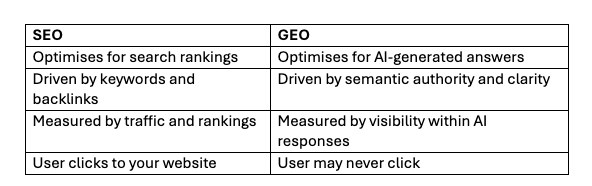
They are not competing disciplines. Strong SEO foundations still matter enormously.
Technical hygiene, clear information architecture and authoritative content all improve your likelihood of being surfaced in generative answers.
But the intent behind the work needs to evolve.
What marketing leaders should be doing now
This isn’t about panic. It’s about adjustment.
1. Audit Your Authority, Not Just Your Keywords
Ask yourself honestly:
Are we publishing expert-led, distinctive insight?
Or are we producing interchangeable content to chase search volume?
Generative engines prioritise clarity, credibility and depth. Thought leadership, robust case studies and genuinely useful resources matter more than ever.
If your positioning is vague, AI will struggle to interpret you. And if it can’t interpret you, it won’t reference you.
Clarity wins.
2. Structure content for machines and humans
Good content now needs to be:
– Logically organised
– Written in natural language
– Rich in context
– Clearly structured
Schema, clean heading hierarchies and defined topic clusters aren’t technical nice-to-haves. They’re foundational.
This is where strategy and technology have to work together, not in silos.
3. Invest in brand, not just search terms
Generic content is increasingly invisible.
If your thinking is safe and interchangeable, you won’t stand out, to users or to machines.
Authority is built across channels:
– PR and earned media
– Campaigns
– Digital platforms
– Brand narrative
– Consistent expertise
This is integrated marketing in action. Not fragmented activity. Not isolated tactics.
4. Rethink measurement
Rankings and traffic still matter, but they’re no longer enough.
Leaders should start looking at:
– Share of voice within AI-generated answers
– Growth in branded search
– Direct traffic trends
– Quality of engagement, not just volume
Visibility is now multi-dimensional. Your reporting should reflect that reality.
This isn’t a tweak. It’s an evolution.
SEO vs GEO isn’t a battle.
It’s the next phase of how influence is earned.
Brands that treat this as a minor technical adjustment will fall behind. Brands that recognise it as a strategic shift in how decisions are shaped will move ahead.
The opportunity is significant.
In a world of generative answers, the brands that are clear, distinctive and commercially grounded will be the ones that are surfaced, trusted and chosen.
If you’re reviewing your search strategy for the AI era, don’t just ask how to rank.
Ask how to influence.
That’s the real question.


